
Technology is changing the way we live, work, communicate, and solve everyday problems. From smart devices and automated machines to artificial intelligence and industrial robots, technology has become an important part of modern life. As a result, many parents are exploring new learning opportunities that help children understand technology from an early age.
This has increased interest in schools with robotics lab in Ludhiana, where students may have opportunities to explore robotics, coding, engineering concepts, and practical problem-solving.
Robotics education is not only about building machines. It encourages children to ask questions, experiment with ideas, understand how things work, and learn from their mistakes. When introduced through age-appropriate activities, it can make classroom learning more interactive and engaging.
For parents choosing a school in Ludhiana, understanding the role of robotics and STEM education can help them evaluate whether a school’s learning approach supports their child’s interests and future development.
What Is a Robotics Lab in a School?
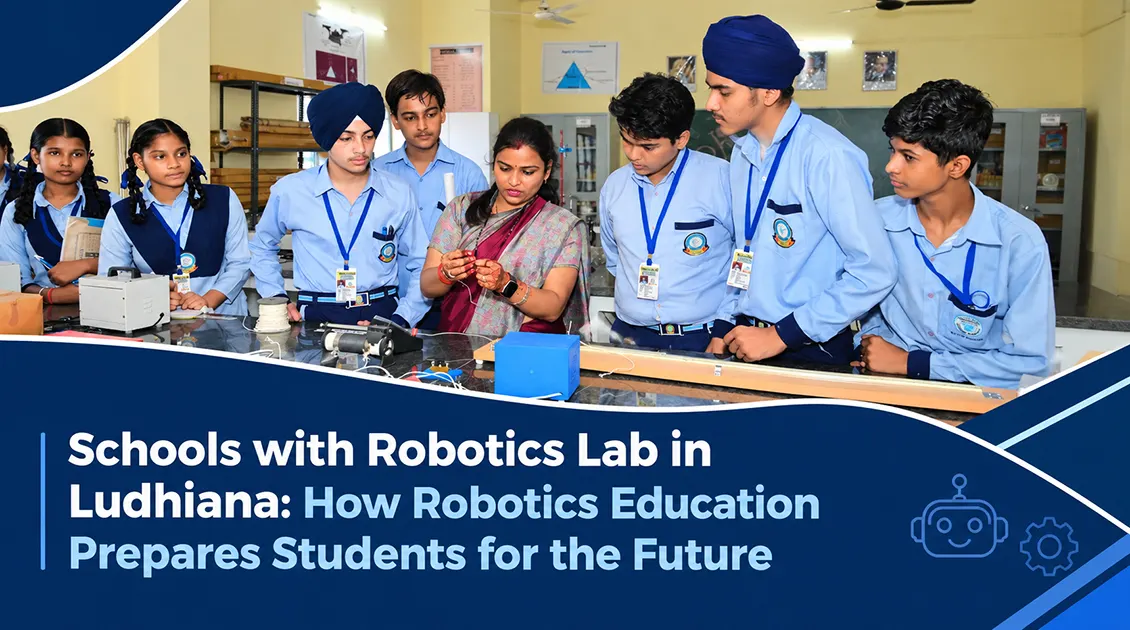
A school robotics lab is a learning space where students can explore robotics and related technologies through practical activities. Depending on the school’s resources and programme, students may work with building kits, sensors, motors, electronic components, coding platforms, or programmable robots.
Instead of learning every concept only through textbooks, students get opportunities to test ideas and observe the results.
For example, a student might build a simple moving robot, programme it to follow a sequence of instructions, or experiment with sensors that help it respond to its surroundings.
These activities introduce scientific and technological concepts in a practical way. The exact equipment, age groups, and learning opportunities vary from school to school.
Why Is Robotics Education Important for Students?
Robotics can connect several areas of learning, including science, technology, engineering, mathematics, and computing. This interdisciplinary approach is often associated with STEM education.
Here are some ways robotics activities can support students’ development.
1. Encourages Logical Thinking
Robotics projects often require students to break a large task into smaller steps. They need to understand the problem, decide what the machine should do, and arrange instructions in the correct sequence.
This process encourages logical thinking and helps students approach challenges in a structured way.
For example, programming a robot to move through a simple route requires students to think about direction, distance, sequence, and possible obstacles.
2. Introduces Coding Concepts
Coding teaches students how to give instructions to a computer or programmable device. In robotics activities, students can see the results of their instructions in the movement or behaviour of a machine.
Younger learners may begin with visual, block-based coding, while older students may progress to more advanced programming concepts depending on their age and curriculum.
Learning through experimentation can make abstract computing concepts easier to understand.
3. Develops Problem-Solving Skills
A robot may not work correctly on the first attempt. A motor might not respond as expected, the instructions may contain an error, or the design may need adjustment.
Students learn to identify the problem, test possible solutions, and improve their work.
This trial-and-improvement process encourages persistence and helps children understand that mistakes can be useful learning opportunities.
4. Builds Creativity and Imagination
Robotics combines technical knowledge with creative thinking. Students can design machines for different purposes, develop solutions to simple challenges, and explore alternative ways to complete a task.
For instance, a classroom project might involve creating a robot that can carry a lightweight object or move around obstacles.
Such activities encourage children to think beyond a single correct answer and explore different possibilities.
5. Promotes Teamwork and Communication
Many robotics projects involve working in small groups. Students may divide responsibilities, share ideas, discuss problems, and test their designs together.
These experiences can help develop communication, collaboration, and the ability to explain ideas clearly.
Students also learn to consider other perspectives when a teammate suggests a different solution.
What Should Parents Look for in Schools with Robotics Lab in Ludhiana?
Not every robotics programme offers the same learning experience. When comparing schools, parents should look beyond the presence of equipment and understand how robotics is incorporated into students’ education.
1. Practical, Hands-On Learning
A useful robotics programme gives students opportunities to participate in activities rather than simply watch demonstrations.
Ask whether students build projects, work with components, write code, and test their designs themselves. Practical participation can help children connect theoretical concepts with real-world applications.
2. Age-Appropriate Activities
Robotics education should match students’ developmental stages and existing knowledge.
Younger children may benefit from simple construction kits, sequencing games, and basic programmable activities. Older students may be ready for sensors, more complex mechanisms, electronics, or text-based programming.
Parents should ask how activities progress as students gain experience.
3. Qualified Guidance and Supervision
Robotics combines several technical subjects, so appropriate guidance is important. Teachers or instructors should be able to explain concepts clearly, support students during projects, and supervise the use of equipment.
Ask how sessions are conducted, how students receive help, and what safety procedures are followed when electrical or mechanical components are used.
4. Integration with STEM Subjects
Robotics can become more meaningful when it connects with classroom learning.
For example, students may apply mathematical concepts when measuring distances, explore physics through movement, use scientific observation during experiments, or practise sequencing through coding.
Parents can ask how robotics activities complement the school’s academic programme.
5. Opportunities to Build Projects
Project-based learning allows students to apply concepts to practical challenges. Depending on the programme, students may create simple automated devices, obstacle-avoiding robots, or other age-appropriate models.
Ask whether students have regular opportunities to complete projects, present their work, and reflect on what they have learned.
6. Suitable Equipment and Maintenance
The quality of a robotics programme depends not only on the equipment available but also on how it is maintained and used.
Parents can ask what types of robotics kits and learning tools are available, which classes use them, and how frequently students participate in practical sessions.
A well-planned programme should provide meaningful learning opportunities suited to students’ age and experience.
Robotics Lab vs Traditional Computer Classes: What Is the Difference?
Both computer education and robotics can help students develop important technology skills, but their learning activities may differ.
Computer classes may focus on digital literacy, using software, programming, presentations, and understanding computer systems.
Robotics activities combine programming with physical components such as motors, sensors, structures, and controllers. Students can observe how software instructions affect a machine’s behaviour.
The two approaches can complement each other. Computer education provides useful digital foundations, while robotics gives students opportunities to apply coding and engineering concepts to physical projects.
The specific learning experience depends on the school’s curriculum and how its programmes are delivered.
How Can Robotics Help Prepare Students for Future Careers?
Students do not need to become engineers or programmers for robotics education to be useful. The skills practised through robotics can support learning across many fields.
These may include logical reasoning, analytical thinking, creativity, teamwork, experimentation, and digital problem-solving.
As students progress, robotics can also introduce them to broader areas such as automation, engineering, electronics, computer science, and artificial intelligence.
However, participation in robotics classes does not guarantee a particular career outcome. The main value at school level is helping students develop curiosity, understand technology, and build a foundation for future learning.
Questions Parents Should Ask Before Choosing a Robotics Programme
If you are comparing schools with robotics lab in Ludhiana, consider asking the following questions during a school visit or admission enquiry:
- Which classes participate in robotics activities?
- What equipment and robotics kits are available?
- Do students build and programme their own projects?
- How often are robotics sessions conducted?
- Are coding and engineering concepts taught at different levels?
- Who guides students during practical activities?
- Are robotics projects connected with science and mathematics?
- Do students have opportunities to demonstrate their projects?
- Are robotics activities included in the regular fee or charged separately?
- What safety procedures are followed during practical sessions?
These questions can help parents understand whether the programme provides regular, meaningful participation or is primarily based on occasional demonstrations.
Indian Public Sr. Sec. School, Ludhiana: Exploring Modern Learning Opportunities
Parents researching schools in Ludhiana can explore Indian Public Sr. Sec. School to learn more about its educational approach and available learning opportunities.
When considering this school or any other institution, families should contact the school directly to confirm whether robotics facilities, coding activities, or STEM programmes are currently available, which classes can participate, and how these activities are organised.
You can visit the official website of Indian Public Sr. Sec. School, Ludhiana to review published school information and enquire about current academic programmes.
It is helpful to ask for specific details about practical learning activities, available equipment, teacher guidance, and any additional programme charges before making a decision.
The aim is to choose a school that supports children’s academic development while encouraging them to explore new ideas and develop skills at an appropriate pace.
Frequently Asked Questions (FAQs)
1. What are schools with robotics lab in Ludhiana?
These are schools that provide a dedicated space or programme for students to learn robotics through activities involving construction, coding, sensors, motors, and programmable devices. The available facilities and curriculum differ between schools, so parents should verify details directly.
2. At what age can students start learning robotics?
Children can begin exploring basic robotics concepts at an early age through simple building activities, sequencing games, and beginner-friendly programmable kits. More advanced coding, electronics, and engineering projects can be introduced as students develop the necessary skills.
3. What do students learn in a school robotics lab?
Depending on their age and programme, students may learn basic coding, mechanical design, logical sequencing, sensor use, problem-solving, teamwork, and how to build and test simple robotic models.
4. Is robotics education useful for students who are not interested in engineering?
Yes. Robotics activities can help develop transferable skills such as logical thinking, creativity, collaboration, experimentation, and problem-solving. These skills can be useful across many academic subjects and career paths.
5. What is the difference between robotics and coding?
Coding involves writing or arranging instructions for computers and digital devices. Robotics applies programming alongside physical components that allow machines to perform tasks. Many robotics programmes combine both areas.
6. How should parents compare robotics facilities in Ludhiana schools?
Parents should ask about equipment, class participation, session frequency, project opportunities, instructor guidance, safety arrangements, and the integration of robotics with academic subjects. A school’s actual teaching practices matter more than equipment alone.
7. Does Indian Public Sr. Sec. School, Ludhiana, have a robotics lab?
Parents should contact Indian Public Sr. Sec. School directly or consult its official website to confirm the current availability of robotics facilities, STEM programmes, and related activities.
Final Thoughts
Robotics education offers students an engaging way to explore technology, experiment with ideas, and develop practical problem-solving skills. By combining coding, construction, and creative thinking, robotics activities can help make STEM learning more interactive.
For parents exploring schools with robotics lab in Ludhiana, the best starting point is to understand what students actually do during robotics sessions, how regularly they participate, and how the programme supports their overall education.
Compare schools carefully, ask specific questions, and verify current facilities before making a decision. A meaningful robotics programme should encourage curiosity, practical learning, collaboration, and a willingness to keep discovering how the world works.